Deutsch
  English
  Français
  Español
  Türkçe
  العربية
  Русский
  Português do Brasil

Direct answer: Wählen boltless (rivet/slot) shelving if you need tool-free assembly, adjustable shelf heights, and moderate loads (up to ~500–1,000 lbs per level) — the right fit for garages, retail backrooms, and general warehouse storage. Choose welded shelving if you need maximum rigidity, permanent high-load duty (1,000+ lbs per level), and vibration resistance in industrial environments — at the cost of fixed shelf positions and heavier freight. For most buyers, boltless shelving wins on value, flexibility, and total cost of ownership.
Schnellvergleichstabelle
| Factor | Schraubenlose Regale | Welded Shelving |
|---|---|---|
| Montage | Tool-free, snap-together (rivets/Z-beams) | Requires welding or bolted structural joints |
| Shelf adjustability | Fully adjustable in ~1″ increments | Fixed — shelves are welded in place |
| Tragfähigkeit | 300–1,000 lbs per level (e.g., 500 lbs for our SP482472-w model) | 1,000+ lbs per level, up to heavy structural ratings |
| Installation time | Minutes per unit, no skilled labor | Hours per unit, needs tools/skilled labor |
| Reconfiguration | Easy — move beams, add levels, expand | Not possible without cutting/welding |
| Moisture/wet areas | Wire mesh decks allow airflow and drainage | Solid welded frames resist moisture well |
| Freight & packaging | Flat-packed in cartons, lower freight cost | Pre-welded, bulky, higher freight cost |
| Am besten für | Garages, retail stores, warehouses, wet basements | Heavy industrial racking, pallet loads, permanent installs |
| Typical cost per unit (US) | $80–$250 (consumer retail) | $150–$500+ depending on duty class |
Was sind schraubenlose Regale?
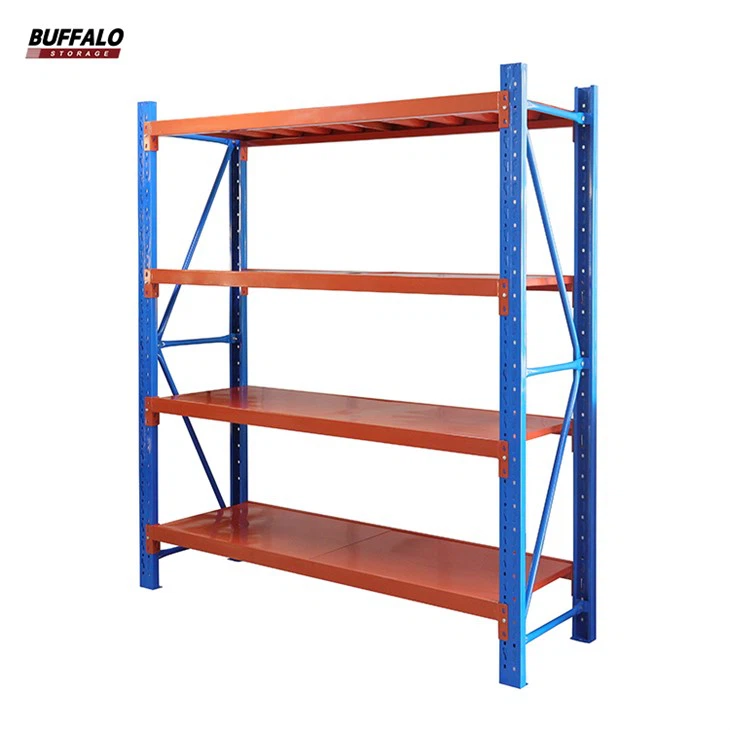
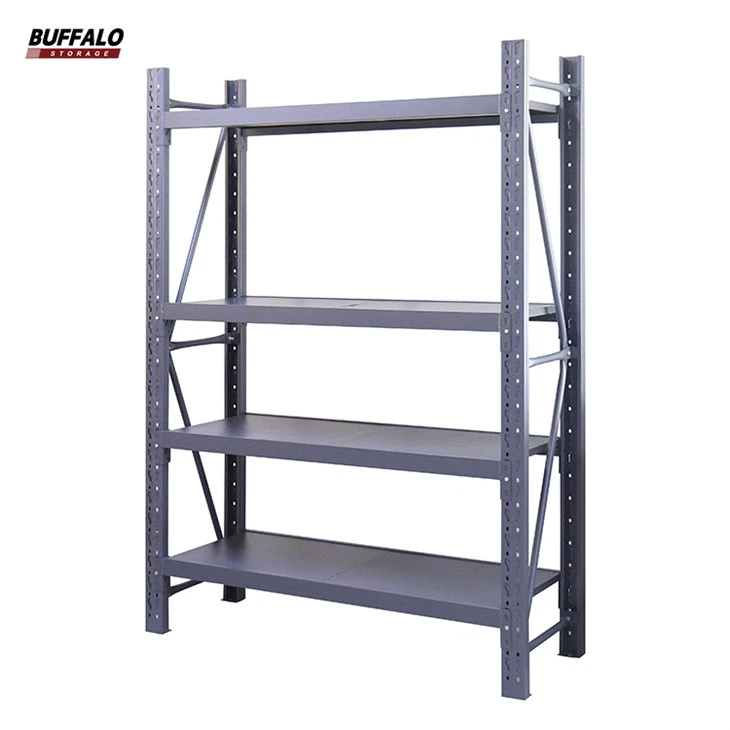
Boltless shelving (also called rivet shelving or slotted shelving) uses a rivet-and-keyhole connection: uprights have punched slots, and beams end in rivet clips that lock in without any nuts, bolts, or tools. Beams can be repositioned at any height increment, so the unit adapts to changing inventory.
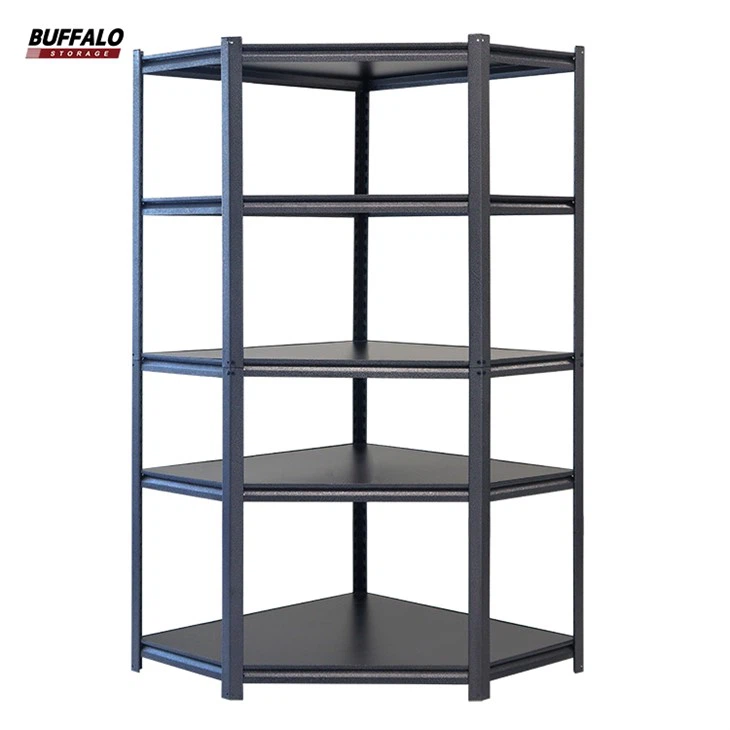
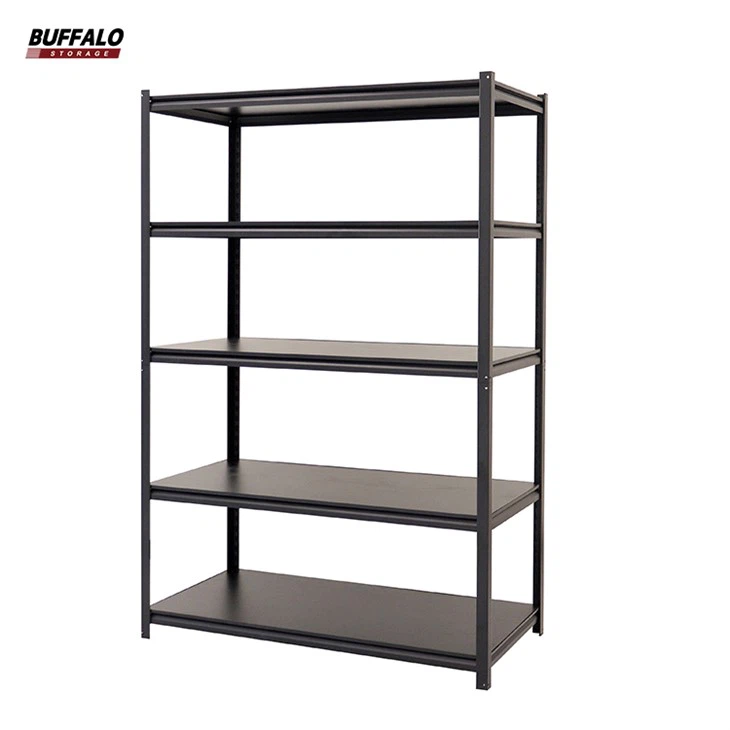
Real-world example from our own factory: our best-selling Heavy Duty Boltless Shelving (model SP482472-w) carries 500 lbs per level across 5 levels on a 48″(W) × 24″(D) × 72″(H) frame — 2,500 lbs of total distributed capacity — using a steel frame, wire mesh deck, and a Z-beam design for extra stability. Assembly takes minutes and needs nothing but two hands.
Strengths:
– Tool-free, fast assembly and disassembly
– Fully adjustable shelf heights
– Wire mesh decks promote airflow (ideal for moisture-prone basements and garages)
– Flat-packed shipping lowers freight cost
– Modular — expand or reconfigure as needs change
Weaknesses:
– Lower maximum load per level than structural welded systems
– Beam-to-upright joints rely on clip engagement — fine for static storage, less ideal under forklift impact
What Is Welded Shelving?
Welded shelving is a one-piece frame where beams are permanently welded to the uprights (or bolted with structural hardware, as in ANSI-design structural rack). The result is a rigid, monolithic unit that transfers load directly through welded joints with no moving parts.
Strengths:
– Highest rigidity and load ratings (structural beams often exceed 1,000 lbs per level)
– No clips to work loose under vibration or impact
– Built to ANSI/RMI design criteria for industrial duty (see ANSI standards)
– Long service life in fixed-layout facilities
Weaknesses:
– Shelf heights are fixed — you cannot adjust levels after manufacture
– Requires tools (and often professional installers) for assembly
– Bulky welded frames cost more to ship
– Reconfiguration or expansion means buying new units
How to Choose by Use Case
Garage or Home Workshop → Boltless
Garage loads (tools, holiday décor, sports gear, paint cans) rarely exceed a few hundred pounds per shelf, and homeowners value adjustability. Industry surveys consistently show garage owners’ top complaint is “lack of space” — vertical, adjustable boltless shelving is the fastest fix. Our Lagerregale aus Metall für die Garage Und schraubenlose Garagenregale are sized exactly for this.
Retail Store or Supermarket Backroom → Boltless
Retail inventory changes seasonally. The ability to move beams in minutes — without calling a maintenance crew — makes rivet shelving the default for retail packing and display. This is why our factory ships rivet-lock shelving for the US retail market and slotted boltless shelving for Europe and Southeast Asia.
Warehouse with Moderate Boxed Loads → Boltless (light-to-medium duty)
For carton storage, e-commerce picking, and general goods up to ~500 lbs per level, boltless systems provide excellent density at lower cost. Wire mesh decks let sprinkler systems see through levels and keep contents visible.
Heavy Industrial / Pallet Loads → Welded or Structural Rack
When loads exceed 1,000 lbs per level, when forklifts traffic the aisles, or when the rack is expected to survive decades in a fixed layout, welded or structural bolted rack (designed per RMI/ANSI MH16.1 criteria) is the correct engineering choice. Welded joints also eliminate clip-shear risk under dynamic loading.
Wet or Moisture-Prone Areas → Boltless with Wire Deck
Both types use painted steel, but wire mesh boltless decks allow air circulation and drainage, preventing moisture buildup on stored goods — a documented advantage for basements and wet workshops.
Cost & Total Cost of Ownership
- Schraubenlos units flat-pack, so freight cost is roughly 30–50% lower than pre-welded units of similar footprint. No skilled labor is required for assembly, which removes installer cost entirely for most buyers.
- Welded/structural units carry higher material, freight, and installation cost, but amortize well in permanent heavy-duty layouts where replacement frequency is low.
Rule of thumb: if you can answer “our loads are under 1,000 lbs per level and our layout changes,” boltless will cost you less today Und tomorrow.
Safety & Standards
Whichever system you choose, follow storage-safety fundamentals:
- Never overload beyond rated capacity. Overloading is a leading cause of rack failure (OSHA, general requirements for storage, 29 CFR 1926.250).
- Anchor tall units to the floor in seismic or high-traffic zones.
- Inspect joints and beams regularly for damage; report loose components immediately (HSE, “Warehousing and storage: Keep it safe”).
- Never climb on racks — racks are not ladders (Wikipedia: Pallet racking, safety considerations).
Häufig gestellte Fragen
Q: Can boltless shelving hold heavy items like tool boxes or car parts?
A: Yes, within rated limits. Our Heavy Duty Boltless Shelving carries 500 lbs per level (2,500 lbs total on a 5-level unit) — more than enough for tool boxes, auto parts, and bulk retail goods.
Q: Is boltless shelving as strong as welded shelving?
A: No — welded/structural systems hold more per level. But for the 90% of garage, retail, and light-warehouse applications, boltless strength is more than sufficient, and it costs less.
Q: Can I adjust the shelf heights later?
A: With boltless shelving, yes — beams reposition in seconds. With welded shelving, no; shelf positions are permanent.
Q: Does boltless shelving rust in a humid garage?
A: Units are powder-coated steel; wire mesh decks let air circulate, which actively reduces condensation on stored goods. Keep the coating intact and wipe spills promptly.
Q: What does “boltless” actually mean?
A: Beams lock into slotted uprights with rivet clips — no nuts, bolts, or tools. Also called rivet shelving, slot shelving, or clip shelving.
Q: How much does a boltless shelving unit cost?
A: Consumer retail units typically range $80–$250; commercial-grade units with heavier beams sit higher. Freight is lower than welded units because they ship flat-packed.
Q: Do you offer custom sizes or colors?
A: Yes — as a manufacturer (factory in Chaizhen Province, Cambodia, 105 km from Ho Chi Minh City), we offer custom sizes, colors, and carton design. Send us your specs.
Q: Which shelving do supermarkets actually use?
A: Retail backrooms overwhelmingly use boltless rivet shelving because seasonal resets require frequent height changes — that is exactly the market our factory primarily serves.
Why Buyers Trust Buffalo Storage Works
Buffalo Storage Works has manufactured shelving since 2004, supplying 500+ international supermarket and retail stores von 4 global production bases (annual output of 4 million sets). The company holds SGS, BSCI, and ISO certifications plus 20+ patents, and offers 7×24 after-sales support with custom design and proofing. See our factory and capabilities.
Published by Buffalo Storage Works Company Limited — Chaizhen Province, Cambodia. Updated August 2026.
Sources: OSHA 29 CFR 1926.250 — General requirements for storage · ANSI — American National Standards Institute · HSE UK — Warehousing and storage: Keep it safe · Wikipedia — Pallet racking · Buffalo Storage Works product specifications (model SP482472-w)