Français
  English
  Deutsch
  Español
  Türkçe
  العربية
  Русский
  Português do Brasil

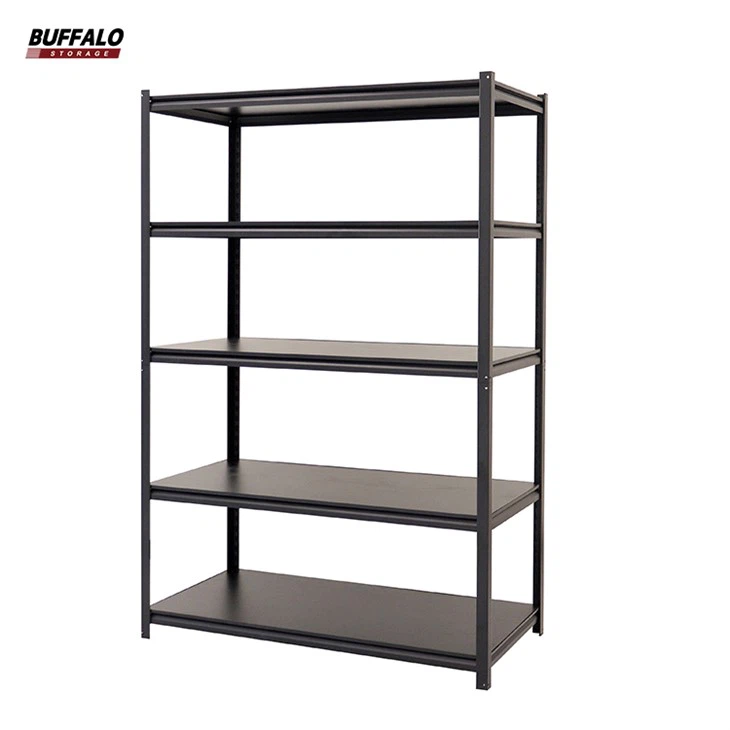
Direct answer: A typical boltless (rivet/slot) shelving unit holds 300–1,000 lbs per level, with total unit capacity ranging from roughly 1,500 to 5,000 lbs depending on beam gauge, upright spacing, and deck type. Our commercial-grade Heavy Duty Boltless Shelving (model SP482472-w) is rated at 500 lbs per level across 5 levels — 2,500 lbs total distributed load — and that is mid-range for the category. Actual capacity depends on four variables: beam thickness, upright gauge, span width, and deck construction.
The Short Load-Capacity Table
| Unit type | Per-level capacity | Typical levels | Total distributed capacity |
|---|---|---|---|
| Light-duty rivet shelving (consumer) | 150–300 lbs | 4–5 | 600–1,500 lbs |
| Standard boltless shelving | 300–500 lbs | 5 | 1,500–2,500 lbs |
| Heavy-duty boltless (e.g., SP482472-w) | 500–1,000 lbs | 5 | 2,500–5,000 lbs |
| Structural/welded rack (industrial) | 1,000–4,000+ lbs | 3–5 | 5,000–20,000+ lbs |
What Determines Boltless Shelving Load Capacity?
1. Beam Gauge (Thickness)
The horizontal beams carry the load. Thicker steel (e.g., 1.0–1.5 mm vs 0.6–0.8 mm) roughly doubles per-level capacity. Heavy-duty units use Z-beam or box-beam profiles specifically to resist bending under 500+ lb loads.
2. Upright Gauge and Column Design
Uprights transfer load to the floor. Commercial uprights are roll-formed steel with punched slots; heavier gauges and reinforced column profiles support taller, heavier configurations.
3. Span Width
The wider the shelf, the lower the capacity. A 48″-wide beam rated 500 lbs may be rated only 400 lbs at 60″ width. Always check the rated capacity at votre span, not the maximum number on the spec sheet.
4. Deck Type
- Wire mesh deck: distributes weight, allows airflow, keeps small items from falling through — our standard for heavy-duty units.
- Particle board / MDF deck: lower cost, sensitive to moisture, lower point-load tolerance.
- Solid steel deck: highest distributed capacity, but blocks sprinkler coverage in commercial settings (a fire-inspection concern).
Real Spec Sheet Example: Model SP482472-w
| Spec | Valeur |
|---|---|
| Model | SP482472-w |
| Matériel | Steel frame + wire mesh deck |
| Levels | 5 |
| Montants | 8 pièces |
| poutre en Z | 20 pcs |
| Barre transversale centrale | 5 pcs |
| Capacité de charge | 500 lbs per level |
| Total distributed capacity | 2,500 lbs |
| Dimensions | 48″(W) × 24″(D) × 72″(H) |
| Finish | Electrostatic powder coating (black) |
| Assemblée | Boltless, tool-free |
At 500 lbs per level, this unit comfortably stores tool chests, auto parts, bulk retail cartons, and seasonal garage loads — the most common use cases for boltless buyers. See the full product page for the Étagères robustes sans boulons spec.
Boltless vs Welded Load Capacity: Where the Line Is
- Boltless systems are engineered for static, evenly distributed loads up to ~1,000 lbs per level. The clip-and-rivet joint is extremely reliable under static load within rated limits.
- Welded or structural rack takes over above ~1,000 lbs per level, under forklift traffic, or where dynamic impact is expected — joints are permanent, so there is no clip to shear. This is why ANSI/RMI standards treat structural rack as a distinct engineering class.
Rule of thumb for buyers: ≤ 500 lbs per level and a changing layout → boltless; > 1,000 lbs per level or forklift traffic → structural rack. The 500–1,000 lb band depends on beam gauge and can be served either way.
7 Rules for Safe Loading
- Distribute weight evenly across each level — point loads can exceed the beam rating.
- Never exceed the rated per-level capacity, even if the total seems fine (OSHA storage requirements).
- Anchor tall units (72″+) to the wall or floor, especially in seismic zones.
- Check beam engagement after assembly — a beam that is not fully seated is unrated.
- Inspect monthly for bent beams, deformed slots, or rust (HSE warehousing safety guide).
- Never climb on shelves — racks are not ladders (safety notes on pallet racking).
- Match deck to content: wire mesh for heavy/odd-shaped items, solid deck only when fire code allows.
FAQ
Q: How much weight can a standard boltless shelving unit hold?
A: Typically 300–500 lbs per level for standard units and 500–1,000 lbs for heavy-duty units. Our SP482472-w is rated 500 lbs per level, 2,500 lbs total across 5 levels.
Q: Can boltless shelving hold engine blocks or car parts?
A: Within rated limits, yes — 500 lbs per level handles most auto parts, tool boxes, and loaded bins. For pallet loads or continuous >1,000 lb levels, choose structural rack instead.
Q: Does the shelf width affect the weight limit?
A: Yes, directly. Longer spans bend more; a 48″ beam rated 500 lbs is typically rated lower at 60–72″. Always use the rating at your actual span.
Q: Is a wire mesh deck stronger than a particle board deck?
A: For point loads and moisture resistance, yes. Wire mesh also lets air circulate and keeps small items from falling through. Particle board is cheaper but weaker per point-load and moisture-sensitive.
Q: How do I know my unit is loaded safely?
A: Three checks: each level’s load ≤ its rating, weight distributed evenly, and total ≤ unit rating. Add floor anchoring for tall units and monthly visual inspections.
Q: What is the difference between “per level” and “total” capacity?
A: Per-level capacity is the maximum for one shelf; total capacity is the sum across all levels. A 5-level unit at 500 lbs/level has 2,500 lbs total distributed capacity — not 2,500 lbs on one shelf.
Q: Do you make heavier boltless units?
A: Yes — we manufacture custom sizes, beam gauges, and load ratings to spec. Tell us your load and span, and we will engineer the unit (Contactez-nous).
Q: How should I store heavy items on a wire mesh deck?
A: Use a plywood or rubber mat to spread point loads, place heaviest items directly over beams (not mid-span), and keep weight under the per-level rating.
Why Buyers Trust Buffalo Storage Works
Buffalo Storage Works has manufactured shelving since 2004 for 500+ international supermarket and retail stores across 4 global production bases (4 million sets annually). Certified SGS, BSCI, and ISO with 20+ patents, the company offers custom design, proofing, and 7×24 after-sales support from its factory in Chaizhen Province, Cambodia — 105 km from Ho Chi Minh City, 123 km from Phnom Penh International Airport. Explore étagères de stockage industrielles ou étagères de rangement de garage en métal for more options.
Published by Buffalo Storage Works Company Limited — Chaizhen Province, Cambodia. Updated August 2026.
Sources: OSHA 29 CFR 1926.250 — General requirements for storage · ANSI — American National Standards Institute · HSE UK — Warehousing and storage: Keep it safe · Wikipedia — Pallet racking · Buffalo Storage Works product specifications (model SP482472-w)