Português do Brasil
  English
  Français
  Deutsch
  Español
  Türkçe
  العربية
  Русский

Direct answer: Choose heavy duty shelving by matching five variables to your real load: (1) per-level weight you need to hold, (2) footprint and ceiling height of the space, (3) environment (humidity, temperature, forklift traffic), (4) rack type — boltless rivet shelving for adjustable moderate loads, structural/welded rack for 1,000+ lb static or dynamic loads, and (5) a verified manufacturer with load-test documentation and certifications. The most common mistake buyers make is buying on price per unit instead of cost per level-year — a 500 lbs-per-level unit that fails early costs far more than a heavier-rated unit that lasts a decade.
The 5-Step Decision Framework
Step 1 — Define Your Real Load (Per Level, Not Per Unit)
Every shelving spec sheet lists both per-level capacity e total distributed capacity. Buyers who only look at the total number overestimate what they can store. Rule: take the heaviest single item you plan to put on one shelf, add 25% safety margin, and buy a unit rated at least that high per level.
| Typical use case | Recommended per-level rating |
|---|---|
| Light retail display, small cartons | 150–300 lbs |
| Standard garage / workshop storage | 300–500 lbs |
| Bulk retail cartons, auto parts, tool chests | 500–1,000 lbs |
| Pallet loads, industrial components | 1,000–4,000+ lbs (structural) |
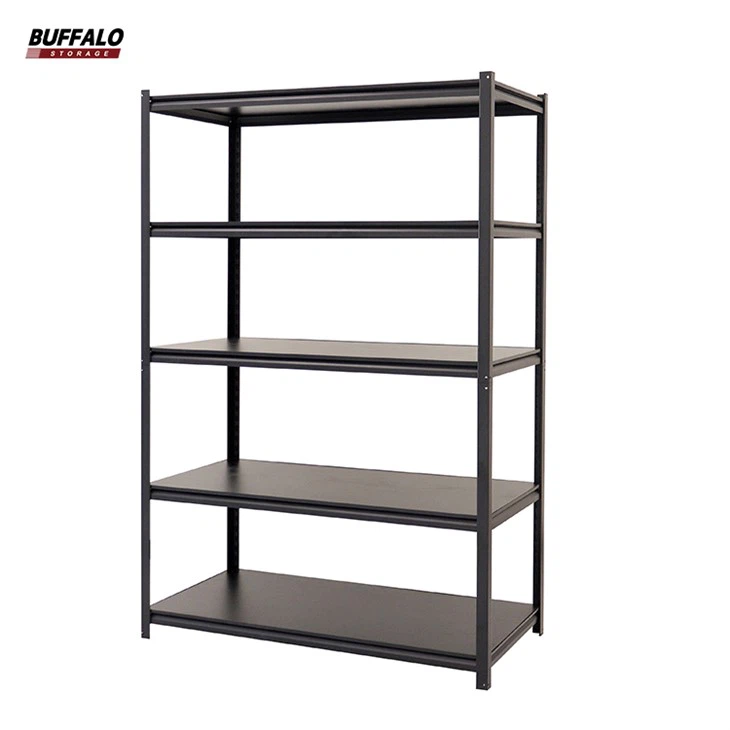
Our Heavy Duty Boltless Shelving (SP482472-w) is rated 500 lbs per level across 5 levels — squarely in the bulk-retail and garage range, and the most popular rating we ship.
Step 2 — Measure the Space (Footprint + Height + Aisle)
- Footprint: note width, depth and quantity of units that fit the bay.
- Altura: a 72-inch unit fits most garages and retail backrooms; taller industrial racking (96″+) requires ceiling clearance and often floor anchoring.
- Aisle width: if forklifts or pallet jacks will move loads, aisles need to be wider than the unit depth — a frequent planning miss.
Step 3 — Check the Environment
- Humidity / wet areas (garages, basements): choose wire mesh decks for airflow and drainage; verify powder-coating quality to resist rust (OSHA general storage requirements cover basic housekeeping, but coating spec is a manufacturer question).
- Forklift traffic: impact risk means you want either structural rack designed to ANSI/RMI criteria or boltless units positioned away from traffic lanes.
- Fire sprinklers: wire mesh decks allow sprinkler coverage between levels; solid steel decks can block it — a compliance consideration in commercial settings.
Step 4 — Pick the Rack Type
| Factor | Boltless (rivet) shelving | Structural / welded rack |
|---|---|---|
| Per-level capacity | 300–1,000 lbs | 1,000–4,000+ lbs |
| Shelf adjustability | Fully adjustable (~1″ increments) | Fixed |
| Conjunto | Tool-free, minutes | Bolts/welds, often professional install |
| Reconfiguration | Easy, modular | Not practical |
| Typical buyer | Garages, retail, light warehouse | Industrial, pallet storage |
| Freight | Flat-packed, lower cost | Bulky, higher cost |
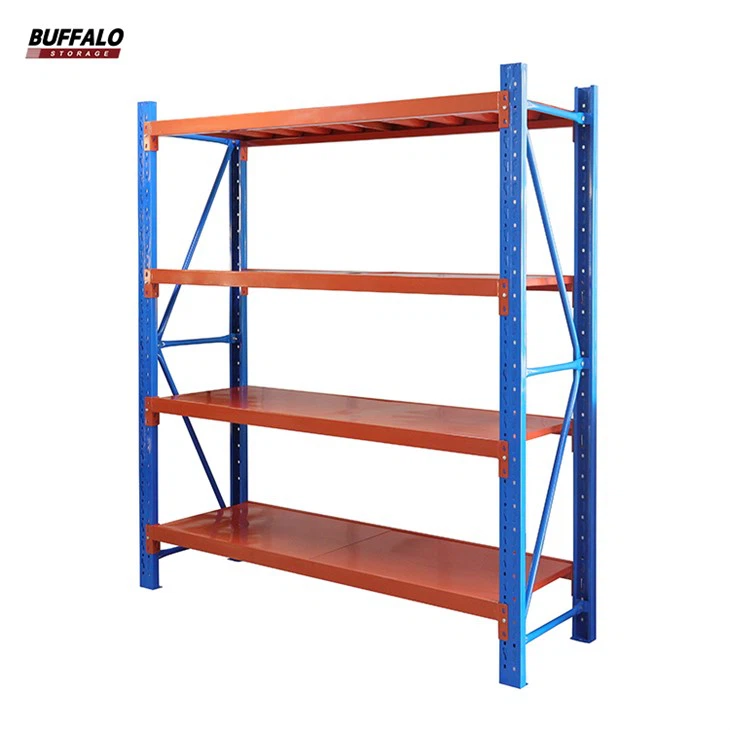
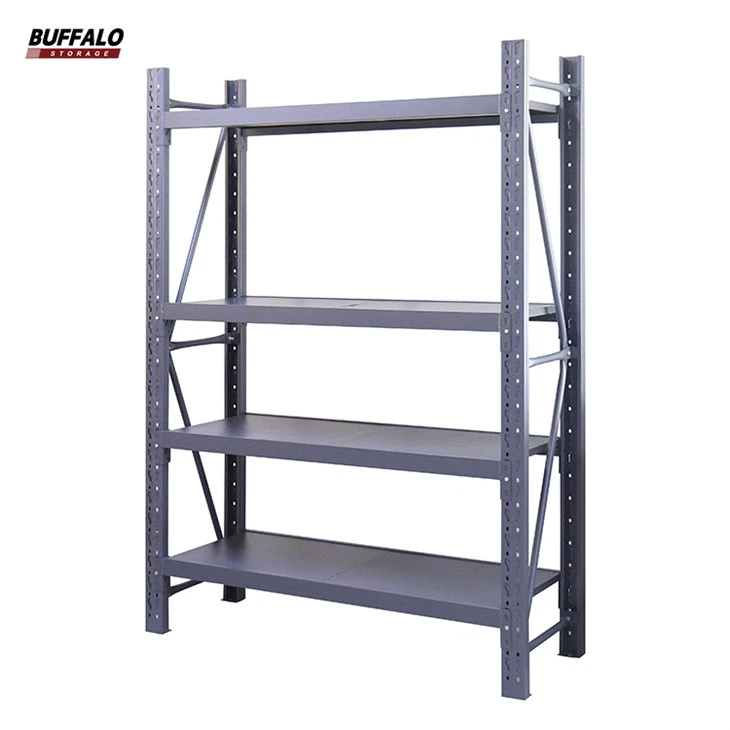
If your loads are under ~1,000 lbs per level and your layout changes seasonally, boltless is almost always the right economic choice. Above that, or under forklift impact, structural rack is the engineering answer. See our detailed boltless vs welded comparison for the full breakdown.
Step 5 — Vet the Manufacturer (Certifications + Documentation)
A spec sheet is a promise; documentation is proof. Before ordering, ask for:
- Load-test reports for the exact model (not a sister model).
- Certificações: SGS, BSCI, ISO 9001 or equivalent — and ask which audits the certificates actually cover.
- Factory address and production photos/video: verify the seller is a manufacturer, not a trader.
- Warranty and after-sales: response time, spare parts availability, and what happens with damaged cartons.
- Reference customers: 2–3 named retail or warehouse accounts you can contact.
Real Spec Example: SP482472-w (What “Heavy Duty” Actually Looks Like)
| Spec | Valor |
|---|---|
| Model | SP482472-w |
| Material | Steel frame + wire mesh deck |
| Levels | 5 |
| Verticais | 8 peças |
| Viga Z | 20 pcs |
| Barra transversal do meio | 5 pcs |
| Capacidade de carga | 500 lbs per level |
| Total distributed capacity | 2,500 lbs |
| Dimensions | 48″(W) × 24″(D) × 72″(H) |
| Finish | Electrostatic powder coating (black) |
| Conjunto | Boltless, tool-free |
Buyers often ask how this compares to lighter consumer units — the answer is in the beam gauge: heavy-duty units use Z-beam or box-beam profiles that resist bending, whereas light consumer units use thinner C-channel (load-capacity explainer).
Cost Model: Per-Level-Year, Not Per Unit
Two units with identical footprint can differ 40% in price because of beam gauge, upright gauge, and deck type. Compare them on price ÷ (levels × per-level capacity × expected years of service). A $120 light unit rated 300 lbs/level that must be replaced in 3 years is more expensive than a $200 heavy-duty unit rated 500 lbs/level lasting 10 years — the light unit costs roughly 2.5× more per level-year.
7-Point Pre-Order Checklist
- ☐ Per-level capacity ≥ heaviest single item × 1.25 safety margin
- ☐ Total distributed capacity ≥ sum of planned loads
- ☐ Unit height fits ceiling with clearance; tall units get floor/wall anchors (safe loading rules)
- ☐ Deck type matches environment (wire mesh for moisture; solid deck only if fire code allows)
- ☐ Aisle width accommodates your material handling equipment
- ☐ Manufacturer provides load-test reports + certifications + factory verification (pallet racking safety notes)
- ☐ Spare parts (beams, clips, decks) available for future reconfiguration
Perguntas frequentes
Q: How much weight should “heavy duty” shelving hold per level?
A: Industry convention puts heavy duty at 500–1,000 lbs per level. Below that is standard duty; above 1,000 lbs per level you are usually in structural rack territory. Our SP482472-w sits at 500 lbs per level, 2,500 lbs total on 5 levels.
Q: Boltless or welded for a warehouse?
A: For loads under ~1,000 lbs per level with changing layouts, boltless wins on cost and flexibility. For pallet loads, forklift impact, or permanent high-load installs, choose structural/welded rack.
Q: What is the most important spec to check?
A: Per-level capacity at your actual span width — ratings change with span. A 48-inch beam rated 500 lbs may be rated lower at 60–72 inches.
Q: Do I need to anchor heavy duty shelving?
A: Units 72″ and taller should be anchored to the wall or floor, especially in seismic zones or high-traffic areas. Anchoring kits are inexpensive relative to the collapse risk.
Q: Can I get custom sizes and load ratings?
A: Yes — as a manufacturer we engineer custom sizes, beam gauges, and load ratings to spec. Send your load and span to our team for a quote (Contate-nos).
Q: How do I verify a shelving supplier is a real manufacturer?
A: Ask for factory address, production photos/video, SGS/BSCI/ISO certificates, load-test reports for the exact model, and 2–3 reference customers. A manufacturer should answer all five without hesitation.
Q: What is the lifespan of heavy duty boltless shelving?
A: With correct loading and powder-coated steel in a dry environment, 10+ years is normal. Monthly visual inspections catch bent beams or rusted slots early (HSE warehousing guide).
Q: Is wire mesh or particle board deck better?
A: Wire mesh distributes point loads, allows airflow, and keeps small items from falling — our standard for heavy duty. Particle board is cheaper but moisture-sensitive and weaker per point-load.
Why Buyers Trust Buffalo Storage Works
Buffalo Storage Works has manufactured shelving since 2004, supplying 500+ international supermarket and retail stores de 4 global production bases (annual output of 4 million sets), certified SGS, BSCI and ISO with 20+ patents. We publish real load ratings, support custom design and proofing, and answer within 24 hours on after-sales. Browse prateleiras de armazenamento industrial or the prateleiras resistentes sem parafusos product page, or tell us what you need.
Published by Buffalo Storage Works Company Limited — Chaizhen Province, Cambodia. Updated August 2026.
Sources: OSHA — storage and materials handling · ANSI/RMI — rack design standards · HSE UK — Warehousing and storage: Keep it safe · Wikipedia — Pallet racking · Buffalo Storage Works product specifications (model SP482472-w)