Türkçe
  English
  Français
  Deutsch
  Español
  العربية
  Русский
  Português do Brasil

Struggling to trust particle board with your valuable inventory? A collapsing shelf is a disaster for safety and your bottom line. You need to know the real numbers.
The weight capacity of particle board is not a single number. It’s a calculation based on the board’s thickness, density, the span between supports, and how the load is distributed. For industrial applications, the supporting steel frame is the most critical factor.
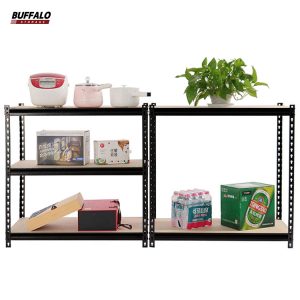
As an engineer, I look at shelving as a complete system, not just a plank of wood. The “it depends” answer isn’t a cop-out; it’s the start of a proper technical evaluation. Too many businesses get this wrong by focusing only on the decking material. They either overspend on materials they don’t need or, far worse, they create a safety hazard by under-specifying their shelves. Let’s move beyond guesswork. We’re going to break down the material science, the engineering principles, and the practical applications so you can make an informed, safe, and cost-effective decision for your operation. This is the manufacturer’s deep dive you won’t get from a reseller.
What Exactly Is Particle Board?
You see particle board everywhere, but do you know what it really is? Misunderstanding its composition is the first step toward catastrophic failure. I’ll explain its engineered DNA.
Particle board is an engineered wood composite made from wood chips, sawmill shavings, and sawdust, all bound together with a synthetic resin and pressed under intense heat and pressure. Its strength is dictated by particle size, resin type, and final density.
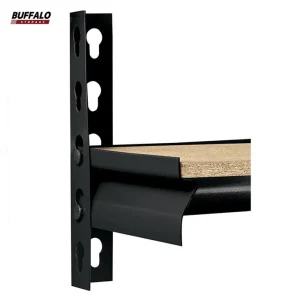
From a manufacturing standpoint, not all particle board is created equal. The term itself covers a wide range of products. When we specify decking for our shelving systems, we’re not just buying a commodity product. We are ordering to a specific standard.
Understanding Particle Board Grades
The final properties of the board depend entirely on the manufacturing process. The size and shape of the wood particles, the type and amount of resin used, and the pressure applied all contribute to the final product’s performance.
| Grade | Key Characteristics | Best Use Case |
|---|---|---|
| Standard Grade (LD) | Low-Density, larger particles. | Light furniture, temporary structures. Not for industrial shelving. |
| Industrial Grade (M-Grade) | Medium-to-High Density, fine particles, more resin. | Shelving decks, countertops, commercial fixtures. |
| Moisture-Resistant (MR) | Includes moisture-repellent resins. | Kitchens, bathrooms, environments with humidity fluctuations. |
| Fire-Retardant (FR) | Treated with fire-retardant chemicals. | Required for specific building codes and safety applications. |
For our heavy-duty shelving, we exclusively use industrial-grade, high-density board. This ensures it can withstand the point loads and daily abuse of a warehouse environment when properly supported by our steel frames. We’ve rejected entire shipments for not meeting our density and resin specifications. Quality control at the material level is non-negotiable.
What Is the Real Weight Capacity of Particle Board?
You see a weight rating on a box, but can you really trust it? Overloading is a silent threat that puts your people and products at immense risk.
The weight capacity is a function of the entire shelving system. A 3/4-inch industrial-grade board can support over 1,500 lbs, but only if the span is narrow and the load is transferred to a heavy-duty steel frame. The board itself is just one component.
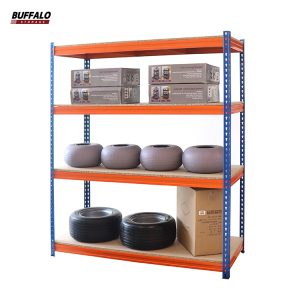
I once visited a facility where the operations manager was proud of the “heavy-duty” shelves he’d built himself. He used thick 1-inch particle board but spanned it across 6-foot gaps with flimsy supports. The shelves were already visibly sagging, a phenomenon engineers call “creep.” He was mistaking thickness for strength and ignoring the most critical factor: the support structure. This is a classic, dangerous mistake. A properly engineered system uses the steel frame to do the heavy lifting, allowing the particle board to function as a stable deck.
Key Factors Influencing Load Capacity
- Span: This is the distance between supports. It is the single most important variable. As the span increases, the weight capacity of the board decreases exponentially.
- Thickness & Density: A thicker, denser board is inherently stronger and more rigid than a thin, low-density one. For any serious application, 3/4-inch (18mm) is the typical starting point.
- Yük Dağılımı: A Uniformly Distributed Load (UDL) spreads the weight evenly across the surface. A point load concentrates all the force in one small area, which the board is not designed to handle alone.
- The Support System: This is the game-changer. A steel support beam running down the center of the shelf dramatically increases its capacity by cutting the effective span in half.
Look at how span cripples capacity for a standalone board:
| Shelf Span | Estimated Capacity (3/4″ Board, UDL) |
|---|---|
| 24 inches | ~85 lbs |
| 36 inches | ~40 lbs |
| 48 inches | ~20 lbs |
These numbers are for the board alone. When integrated into our boltless rivet shelving frames, that same board is part of a system rated for thousands of pounds, because the steel is bearing the load.
How Can You Engineer More Strength Into Particle Board Shelving?
Your standard particle board shelf is sagging, and you’re worried about a complete failure. You need to reinforce it, but how? Here are the proven engineering methods.
True strength comes from system design, not just the board itself. Add steel support beams, decrease the span between uprights, and use a robust frame that transfers the load directly to the vertical posts. This is how you build industrial-grade capacity.
Thinking you can just add a thicker board to solve a strength problem is a common but flawed approach. It’s like putting a thicker roof on a house with weak walls. The foundation of shelving strength lies in the frame that surrounds and supports the decking. At Buffalo Storage Works, we don’t sell shelves; we engineer storage systems where every component works in concert. The particle board provides a smooth, solid surface, but the steel skeleton provides the muscle.
The Critical Role of the Steel Frame
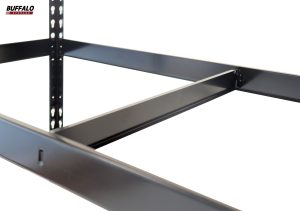
The load path is everything. In our rivet shelving designs, the particle board deck sits inside a perimeter of steel C-channel or Z-beams. Any weight placed on the deck is immediately transferred to these beams.
- Front and Back Beams: These are the primary load-bearers. Our double-rivet Z-beams are engineered to resist torsion and bending under heavy loads.
- Side Beams: These complete the frame, preventing the board from twisting and adding lateral stability.
- Center Support Beams: For wider shelves (typically 48″ and up), we add one or more center supports. This effectively cuts the unsupported span of the particle board in half or thirds, dramatically increasing the system’s overall capacity and preventing the dreaded “creep” or sag over time.
This integrated approach is the only way to safely achieve the high capacity ratings required in a professional warehouse, distribution center, or retail backroom. The board and the frame become a composite structure, stronger than the sum of its parts.
Can Thin Particle or MDF Boards Handle Industrial Loads?
Trying to save a few dollars by using thin 9mm particle board or 5mm MDF? This decision will lead to rapid failure, damaged goods, and a serious safety hazard.
Absolutely not. A 9mm particle board or a 4/5mm MDF board has negligible structural capacity. They are unsafe for any industrial or commercial shelving application beyond use as a thin liner or backer for a display case. Their load-bearing potential is minimal.
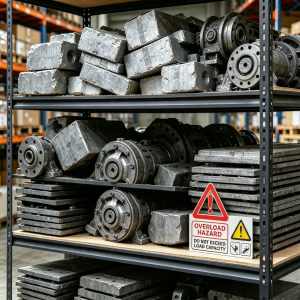
I see this question come from procurement managers trying to hit a cost target without understanding the engineering implications. The perceived savings are a mirage. The cost of a single shelf failure—in damaged product, operational downtime, and potential injury—will erase any upfront material savings a hundred times over. For any application where you are storing items of value or weight, using thin boards is negligent.
A Clear Comparison of Unsuitable Materials
Let’s put this into a practical context. These materials have their uses, but primary load-bearing in a warehouse is not one of them.
| Board Type | Typical Professional Use | Industrial Shelving Suitability | Key Weakness for Shelving |
|---|---|---|---|
| 5mm Particle Board | Cabinet backing, drawer bottoms, temporary displays | Unsafe / Not Recommended | Extremely prone to sag (creep) and fracture under load. |
| 2/3mm MDF Board | Picture frame backing, craft projects, door skins | None | Brittle, very low impact resistance, and almost no load capacity over any span. |
| 3/4″ (18mm) Industrial PB | Professional Shelving Decking | High (within a steel frame) | Requires a properly engineered support system to reach full potential. |
The takeaway is simple: focusing on thin boards for industrial shelving is the wrong conversation. The minimum standard for professional-grade decking is a 5/8″ to 3/4″ (15mm to 18mm) industrial-density board. Even then, its performance is entirely dependent on the quality of the steel frame supporting it. Don’t risk your operation on flimsy materials.
MDF vs. Particle Board: Which Is the Right Choice for Shelving?
MDF feels smoother and looks denser, so it must be stronger, right? This is a dangerous assumption that can lead to costly mistakes and unsafe shelving applications.
For most heavy-duty boltless shelving systems, high-density particle board is the superior choice. While MDF has a fine finish, it is heavier, has poor screw-holding power, and is more susceptible to long-term sagging (creep) than particle board of equivalent quality.
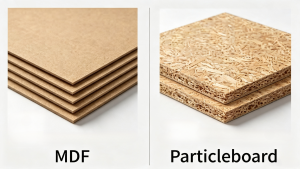
The debate between Medium-Density Fiberboard (MDF) and particle board is a common one, but for our applications, the physics are clear. MDF is made of very fine, uniform wood fibers, giving it that smooth, paintable surface. Particle board is made of larger wood chips. This difference in composition dictates their performance under load. I’ve seen far too many custom-built retail fixtures made from MDF that begin to sag within months. For reliable, long-term storage, the structural integrity of particle board is better suited for the job.
Quality, Disadvantages, and Practical Limits
Let’s break down the key questions to reveal why we specify particle board for our systems.
- Which is better quality? “Quality” depends on the application. For a painted cabinet door, MDF is superior due to its smooth, uniform surface. For a shelving deck that needs to resist long-term load and potential impacts, industrial-grade particle board’s internal structure of cross-linked particles provides better stiffness and impact resistance.
- What are the disadvantages of MDF?
- Creep: Under a sustained load, the fine fibers in MDF are more prone to slowly deform and sag than the larger chips in particle board.
- Weight: MDF is significantly denser and heavier than particle board, adding unnecessary dead load to your shelving structure.
- Screws: You cannot reliably screw into the edge of MDF; it will split. While the face holds screws, its pull-out strength is generally lower than particle board’s.
- Moisture: Standard MDF acts like a sponge when exposed to water, swelling and disintegrating completely. While MR grades exist, it’s a significant vulnerability.
- Why is MDF so cheap? Both are made from wood byproducts, so their cost is tied to the raw material and manufacturing process. The perception of “cheapness” is often based on low-grade, non-structural MDF used in consumer goods. High-quality, industrial-grade MDF and particle board are often priced very similarly. We choose particle board not for cost, but for its superior mechanical properties for shelving applications.
Where Does Particle Board Shelving Excel in a Real-World Warehouse?
You need a versatile storage solution that works across your entire operation. Wondering where a particle board system provides the best value? Let’s look at proven applications.
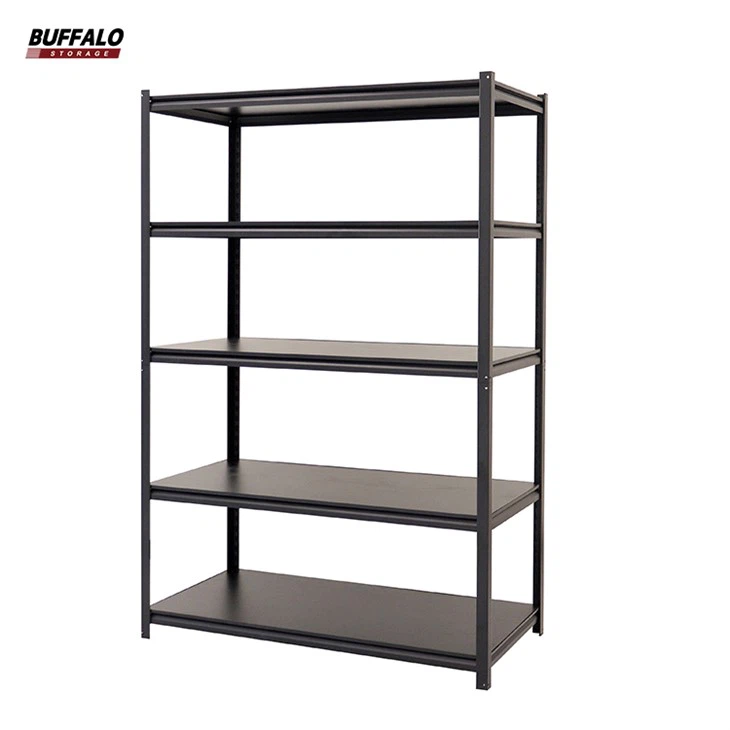
Particle board shelving systems are the workhorses for hand-picked inventory, packaged goods, and items stored in bins or boxes. They are ideal for e-commerce fulfillment centers, retail backrooms, parts departments, and archival storage where you need a solid, flat surface.
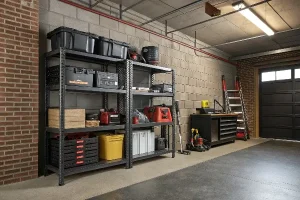
The key is understanding the application. You wouldn’t use this type of shelving for storing raw steel or heavy pallets—that’s what pallet racking is for. But for the vast majority of products that move through a modern warehouse or retail environment, a steel-framed system with particle board decking is the most efficient and cost-effective solution. It provides a continuous, gap-free surface that prevents small items from falling through, something you don’t get with wire decking.
High-Performance Application Scenarios
- E-commerce and 3PL Fulfillment: This is the perfect environment. The shelving holds thousands of different SKUs in small boxes or totes. The solid surface allows for smooth sliding of packages and prevents snagging. Adjustable shelf heights accommodate changing product dimensions.
- Retail Backrooms: Storing apparel, footwear, and general merchandise requires a clean, solid surface. Particle board decking provides this, protecting goods from damage that wire decking can cause. Its high capacity-to-cost ratio is perfect for these environments.
- Automotive and Industrial Parts Storage: Ideal for organizing parts in plastic bins. The solid deck contains any small spills and can easily be fitted with dividers. The high load capacity of our systems handles the weight of dense metal components like brake rotors and fasteners.
- Archival Record Storage: Standard banker’s boxes are perfectly suited for particle board shelving. The UDL capacity of a properly designed system can easily handle the significant weight of paper records, floor to ceiling.
In every case, the particle board is not acting alone. It’s performing as the deck within a rigid, high-strength steel frame that is carrying the load.
How Do Boltless Rivet Systems Maximize Particle Board’s Potential?
Assembling traditional bolted shelving is a slow, frustrating task. You need a system that’s strong, fast to build, and adaptable for the future. This is that system.
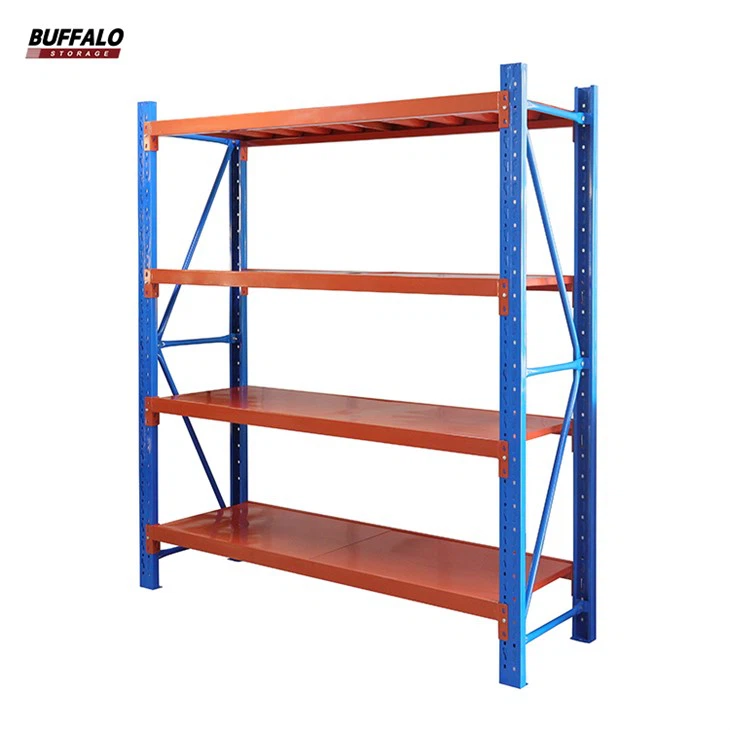
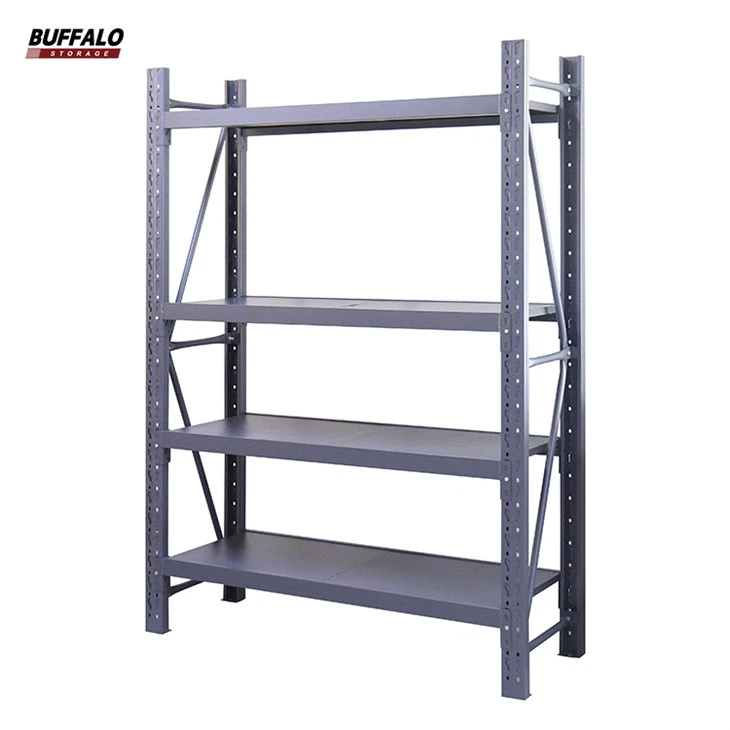
Boltless rivet shelving uses interlocking steel beams and posts that assemble with just a rubber mallet. This design fully supports the particle board deck on all four sides, transferring 100% of the load directly to the high-strength steel frame.
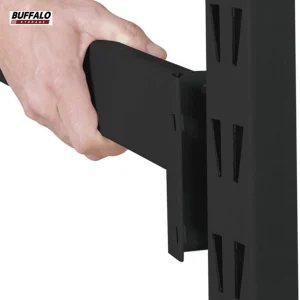
This system represents the smartest application of the materials. It leverages the best properties of both steel and particle board. The steel provides immense tensile strength and rigidity, while the particle board provides a cost-effective, solid, and stable surface. This symbiotic relationship is the core of our design philosophy. We engineer systems that are not just strong, but also intelligent in their use of materials and easy for our customers to deploy and reconfigure.
The Engineering and Supply Chain Advantage
For our large retail and distribution partners in the US and Europe, this system is a strategic asset.
- The System’s Engineering: Double-rivet beams lock into keyhole slots on the vertical posts. This connection becomes tighter and more rigid as you add weight—the load itself strengthens the joint. This eliminates the need for cross-bracing, giving you full access to your stored goods from all four sides. The particle board simply drops into place, fully contained by the steel perimeter.
- Our Global Manufacturing Footprint: We manufacture these high-grade steel frames and pre-cut decking in both our primary R&D facility in China and our state-of-the-art plant in Cambodia. This dual-hub strategy is a direct solution to the challenges our largest clients face. It gives us massive production capacity and, crucially, allows us to supply our American and European partners from a tariff-neutral location. This guarantees supply chain stability, mitigates geopolitical trade risks, and ensures predictable costing for high-volume rollouts. We deliver North American engineering quality through a resilient global supply chain.
This isn’t just shelving; it’s a competitive advantage we provide to our partners.
Çözüm
The right particle board, integrated into a robust steel frame system, offers an exceptionally safe, reliable, and cost-effective solution for most commercial and industrial hand-loading storage requirements.